
Documents Show Real Reason Why the White House Wants to Break Up NCAR
The Equation Read More [[{“value”:”
From aviation safety and improved weather forecasts to products for agricultural planning and flood risk assessment, the National Center for Atmospheric Research (NCAR) plays a foundational role in the nation’s public safety, economic prosperity, and national defense. It is a critical research center that develops and supports tools we rely on to may everyday decisions.
Late on December 16, 2025, Russell Vought, the director of the White House Office of Management and Budget (OMB) announced that NCAR would be broken up and, soon after, the National Science Foundation (NSF), which sponsors NCAR, outlined plans to restructure the center. Already, NSF has stated they will transfer NCAR’s supercomputer, Derecho, to an unknown third-party entity.
At UCS, we sought greater transparency into these proposed and enacted changes. To that end, we have issued a public comment. In addition, we’ve made formal requests to NSF for the cooperative agreement governing NCAR, all public comments submitted during the agency’s request-for-information process, and documentation of internal decision-making involving OMB. These efforts reflect a broader concern within the scientific community: major decisions about national research infrastructure appear to be moving forward without clear public justification or a transparent scientific basis—and that could put critical life-saving science at risk.
Now, through documents released in the ongoing lawsuit brought against NSF and OMB by the University Corporation for Atmospheric Research (UCAR), the manager of NCAR, we are beginning to see why. The documents suggest that the White House OMB directed NSF to restructure and break apart NCAR, and that parts of NCAR’s scientific portfolio were specifically identified to be cut or spun off because they viewed them as misaligned with its political priorities.
Materials submitted by the OMB and NSF provide a substantial window into the thinking behind proposed changes to NCAR. The volume of documentation is significant, including a version of the cooperative agreement between UCAR and NSF, FY27 NSF Budget communications between OMB and NSF, and a NOAA document (Page 30-31) detailing their policy-aligned functions of NCAR activities, and suggested some of NCAR activities be moved to “better-aligned university programs across the country.” For readers interested in the complete record, the April 23 defense filings offer a comprehensive set of materials.
I do, however, want to highlight two key documents that illustrate the direction and intent of the proposed NCAR restructuring.
November 19, 2025 OMB Draft Memo
A draft memo from OMB staff to the OMB director, dated November 19, 2025, outlines a proposed approach to restructuring NCAR, nearly one month before the public announcement by OMB Director Russell Vought on December 16, 2025, that NCAR would be “broken up.”
The memo “directs NSF to accelerate restructuring of NCAR through an RFI [public comment] process”, where key components of its “reform” would include “spin off components of [NCAR]” such as its supercomputer and two aircraft and “rescope the research and modeling of NCAR to focus on weather and not on climate modeling.” A reasoning for doing is that it “will make it easier to align NCAR’s mission more closely with Administration priorities.”
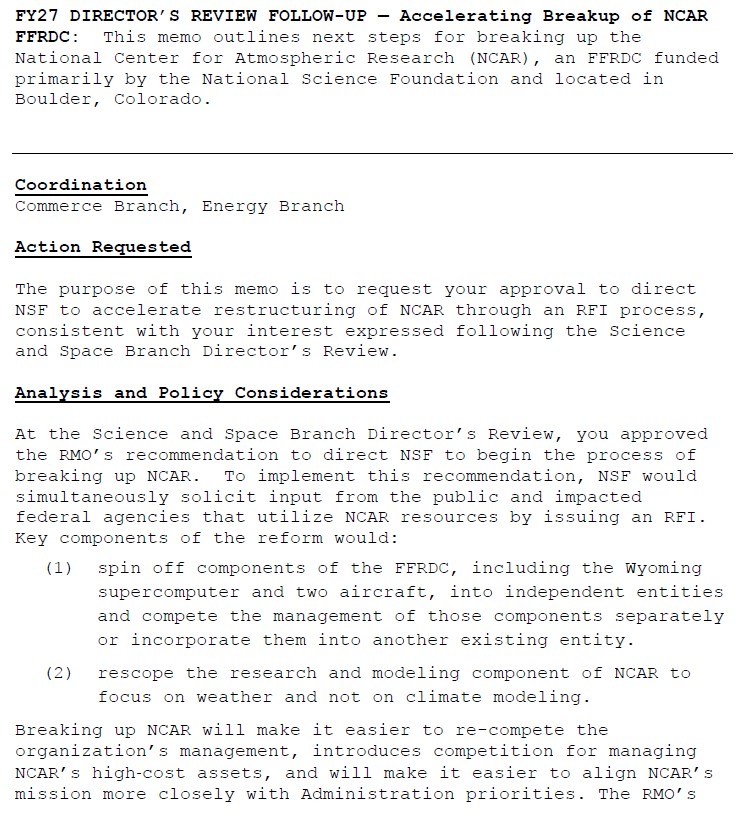
According to the declaration by Stuart Levenbach, associate director for Agriculture, Commerce, Resources, and Science Programs at OMB, the OMB director “considered the information in [the] memo, which ultimately led to the Director’s approval to pursue restructuring NCAR as part of the FY27 budget.”
December 17, 2025 Internal OMB and OMB/NSF Communications
Another document from December 17, 2025, the day after the announcement by Russell Vought, includes Internal OMB communications that identify an initial version of specific areas of NCAR research as misaligned with Administration priorities.
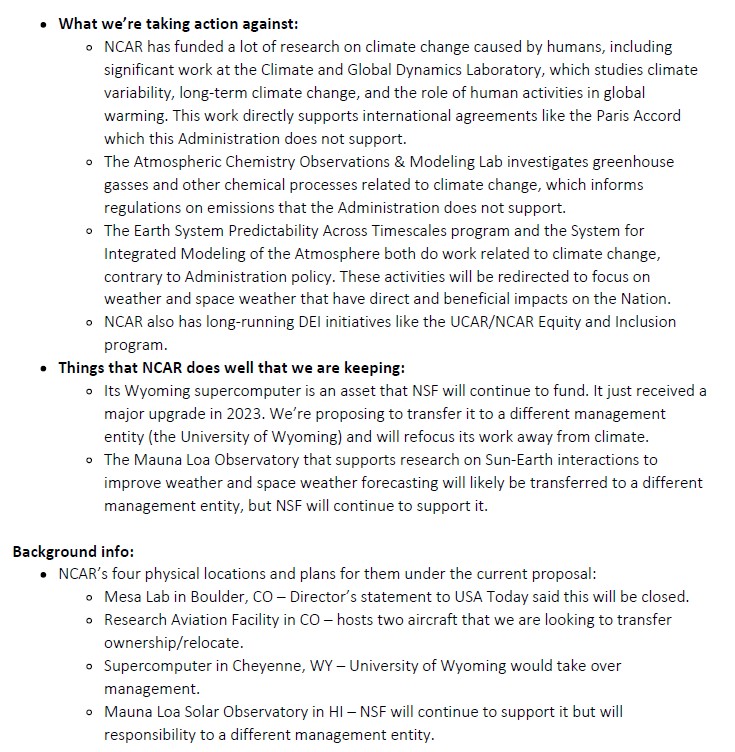
Under “What we’re taking action against” includes work on human-caused climate change and greenhouse gas emissions. Studies on climate variability, long-term fossil fuel-caused climate change, and atmospheric chemistry are singled out as areas to be reduced or redirected, because it “informs regulations on emissions that the Administration does not support.”
At the same time, OMB outlines “Things that NCAR does well that we are keeping,” including its supercomputer and the Mauna Loa Solar Observatory, but these are accompanied by their proposed transfer to “a different management entity.”
Finally, the memo includes background information on NCAR’s physical locations, which includes the proposal of closing NCAR’s Mesa Lab as stated by the OMB director, transferring or relocating its aircraft, and stating the University of Wyoming would take over management of the supercomputer.
Although this was the initial version, Brian Stone, the acting director of the NSF, stated in response that “many” of the NCAR activities OMB suggested for alignment “already track with what we consider aligned.”
All together, these documents reveal a clearer picture as to what kinds of science OMB deemed appropriate for NCAR to be allowed to do (and not do). They also reveal the central role of OMB Director Russell Vought in these actions, and the seeming predeterminations to restructure NCAR before public input was even provided.
- The proposed changes reflect the deliberate effort to redefine the scope of NCAR’s scientific mission. That redefinition has major implications to our public safety, national security, and economic prosperity through the idea that NCAR can be fragmented or have its key components “spun off,” without impacts. They are even making changes to activities they deem NCAR is doing well. What OMB apparently does not understand is that the plan to separate high-performance computing, observational assets, and research labs or programs treats these as standalone capabilities. In practice, they function as an integrated system: models are developed and tested on shared computing infrastructure, observations inform both short-term forecasts and long-term projections, and community access ensures that advances propagate beyond a single institution. Removing pieces of that system weakens the whole.
- The timeline is incredibly fast. It is quite fascinating to see an internal memo between OMB and NSF showing that within mere hours after Vought’s announcement they were on a similar wavelength about which of NCAR’s activities were considered “aligned.” Also, it is clear they were set to implement this for FY27, remarkably fast for any type of restructuring of this nature and essentially tearing up the cooperative agreement that is valid through 2028.
- The documents reveal an attempt to distinguish weather prediction and climate science, but that does not hold up scientifically. Weather prediction and climate understanding are deeply interconnected; they inform each other and are mainly distinguished by different timescales. The NCAR Earth System Predictability Across Timescales Program, which the OMB memo targets, is primarily focused on Subseasonal-to-Seasonal Prediction (S2S), the underdeveloped but critical timescale between weather and climate that informs longer-term forecasting of extreme events and hazards. We cannot fully understand and predict S2S without an understanding of both weather and climate.
- The documents reveal the “likely” management transfer of the Mauna Loa Solar Observatory, which was never explicitly stated in NSF’s ask to the public during its public comment period. Although the Mauna Loa Observatory is operated by NOAA, its solar observations are operated by NCAR. The Solar observatory provides critical observations of the sun’s atmosphere to predict and understand sun-earth interactions to reduce disruptions and damage from space weather hazards (e.g., geomagnetic storms).
- It is more evident that OMB is orchestrating this effort. The fact that OMB was thinking about this well in advance of the official announcement in December of 2025, in addition to their own analysis of NCAR activities, suggests this initiative to break up NCAR is at the behest of the White House’s OMB. It’s also clear that NSF was directed by OMB to develop its Dear Colleague Letter (public comment period), rather than NSF doing it out of its own volition. In my view, and according to these documents, the breakup of NCAR was not something the science agency was considering doing on its own.
These documents from the UCAR lawsuit clearly show the intent by OMB to dismantle NCAR in a fast and rash manner. This is no longer a theory; it is documented that OMB wants this break-up implemented in FY27.
For Congress, this means ensuring oversight: requesting full transparency on proposed changes, reviewing the cooperative agreement with the National Science Foundation, and evaluating whether restructuring would weaken capabilities that support weather forecasting, disaster preparedness, and national security. Congress must hold the Trump administration accountable for the damaging changes it is seeking to push through.
For the public, it means paying attention and speaking up. NCAR’s work underpins forecasts, emergency planning, and risk management tools used every day. Public comment processes, community engagement, and communication with elected representatives all play a role in shaping what happens next. Please see our action alert for how you can reach your senator and representative on the importance of NCAR.
“}]]