
Detroit’s water affordability crisis is tied to the uneven distribution of stormwater management costs – a fraught history explains why
Environment + Energy – The Conversation Read More [[{“value”:”
Beginning in July 2026, Detroiters will be paying higher water and sewer bills.
That’s because The Great Lakes Water Authority, or GLWA, voted unanimously on Feb. 25, 2026, to increase water rates by 5.8% and sewer rates by 4.26% for its customers. GLWA raised rates by similar amounts in 2025.
Residents at GLWA’s last rate hearing spoke of their difficulty keeping up with utility bills. For low-income customers across the GLWA system, rate increases aggravate a deeply entrenched water affordability crisis.
In the coming years, utility bills will likely continue to rise, driven by maintenance costs to upgrade infrastructure nearing the end of its life cycle.
Utility bills are the primary source of revenue for public water and wastewater systems. Yet both the Detroit Water and Sewerage Department, or DWSD, and GLWA are caught in what utility experts call an affordability gap. That is, the discrepancy between what it costs to maintain essential infrastructure and what ratepayers can reasonably afford.
Utilities across the country are facing down a similar contradiction. For DWSD customers, the gap is wider still because they carry a greater burden for water quality improvements that benefit the wider metropolitan region.
I am a political ecologist at Loyola Marymount University, specializing in the politics of resource management in the Great Lakes.
While water affordability is a long-standing concern for communities within the GLWA system and across Michigan, the crisis remains the most acute in Detroit. Taking a look at the fraught history of wastewater management helps to explain why.
Who pays to keep waterways clean?
Since the late 1990s, water bills in Detroit have risen by 400%.
At $87.54 per month, DWSD’s average residential water bill can consume up to 25% of disposable income for households living below the poverty line. The U.S. Environmental Protection Agency sets an affordability threshold of 4.5% of disposable income to cover water bills.
About three-quarters of a DWSD residential water bill pays for wastewater and stormwater treatment. These revenues also help to maintain Detroit’s wastewater treatment plant, which serves the city and 76 suburban communities.
My research, which combined archival research and interviews with state regulators, Detroit city staff, DWSD and GLWA representatives and grassroots water affordability advocates, documents how Detroit’s water affordability crisis involves a less visible form of environmental injustice. This term often describes uneven exposure to pollution or other environmental harms. Detroit’s case raises a different question: Who pays to keep local waterways clean?
Regionalizing Detroit’s wastewater system
Detroit’s wastewater treatment plant is the largest single-site treatment facility in the country. While suburban communities own and operate local sewer systems, they are connected by a regional sewer network that stretches across 944 square miles of Wayne, Oakland and Macomb counties. This network conveys raw sewage to the treatment plant in Detroit.
The wastewater system was not initially designed to serve the metropolitan region, however. It was expanded through the 1950s-70s to help suburban communities address new state wastewater mandates.
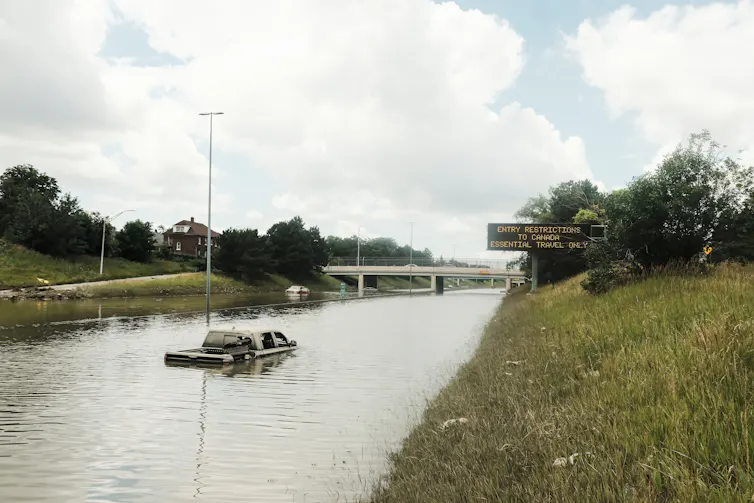
Photo by Matthew Hatcher/SOPA Images/LightRocket via Getty Images
The postwar period is well known for its economic boom, but it also ushered in important social, political and environmental shifts.
Following World War II, for example, local waterways were slick with both industrial and municipal wastes. Polluted waters posed a threat to the safety of people’s drinking water and to Detroit’s water-intensive industrial manufacturers.
In response, Michigan revamped its water pollution law in 1949, requiring cities, towns and villages to install wastewater treatment. Some suburbanizing communities resisted these mandates. They argued their tax bases, then only a few thousand residents, were insufficient to finance such costly infrastructure.
Meanwhile, civil rights organizers in Detroit and across the nation struck down racist segregation laws through the 1960s. Black families began moving into historically white neighborhoods. Following Detroit’s turbulent summer of 1967, demand for suburban housing in all-white communities skyrocketed. More than 40,000 white residents left Detroit for the suburbs that year, a figure that doubled in 1968.
This phenomenon, known as white flight, not only spurred suburbanization but left the tri-county area largely segregated by race and class.
The convergence of stricter water quality laws, suburban growth and white flight also had implications for the wastewater system and its management.
By the late 1950s, Michigan’s Department of Public Health had begun denying sewer permits to developers building in places with insufficient wastewater treatment. Permit denials helped to enforce the state’s wastewater mandates. They became known as “construction bans” for the way they slowed suburban growth.
The quickest way to resolve these “bans” was to route suburban sewage to Detroit. By 1974, DWSD provided wastewater treatment to more than 70 suburban communities across a deeply segregated service area.
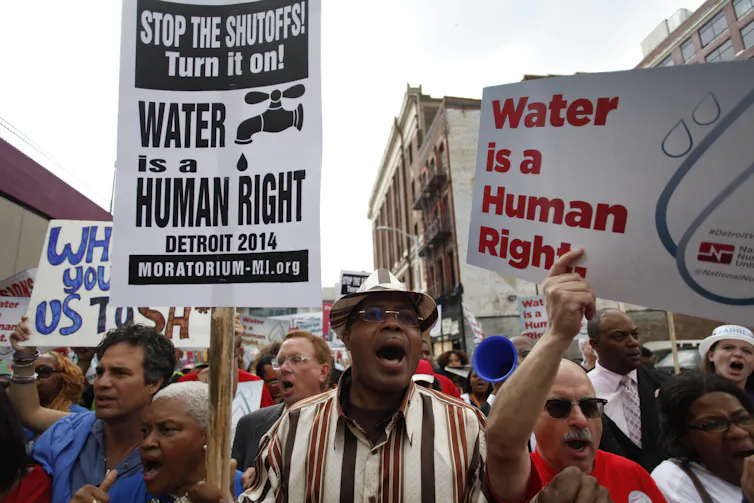
Photo by Joshua Lott/Getty Images
An uneven burden for improving public infrastructure
Regionalizing the wastewater system opened DWSD to suburban political and economic pressure – just as Detroit was becoming a majority-Black city under its first Black mayor, Coleman Young.
In 1975, DWSD hiked sewer rates for both city and suburban customers to finance upgrades for state and federal water quality regulations.
Suburban officials challenged the rate hikes in court, alleging DWSD was attempting to “fleece” the suburbs. While these and future allegations went unsubstantiated, they entrenched long-standing anti-Black stereotypes into the politics of public infrastructure management.
In addition to ongoing rate disputes, suburban politicians introduced “takeover bills” in the state Legislature. The goal was to transfer control of DWSD’s infrastructure to a new regional authority. Both tactics persisted through the 1980s and ’90s, forcing DWSD to make compromises that shifted more costs onto Detroit ratepayers.
A prime example is the 1999 rate settlement agreement that resolved a decade of suburban rate disputes over DWSD’s stormwater charges. Known as “the 83/17 split,” the agreement assigned 83% of stormwater improvement costs to Detroit, while suburban customers shared the remaining 17%, divided 76 ways.
The rates under dispute were introduced to meet new state regulations targeting combined sewer overflows. These overflows occur when pipes release raw sewage and stormwater into waterways during heavy rain. Suburban officials argued for a reduced share of improvement costs. They pointed out many of their sewer systems already separated storm and sanitary pipes, reducing the occurrences of combined sewer overflows. Yet state-mandated improvements required expanding shared infrastructure, not simply combined sewer overflow outlets in Detroit.
GLWA’s own wastewater master plan documents suburban stormwater entering regional sewers long after the 83/17 split was established. Suburban sprawl also paved over vast stretches of land, funneling more runoff into the system.
Nevertheless, the settlement reduced the suburban share of combined sewer overflow improvement costs to 17%. DWSD was ordered to set aside US$10.6 million to reimburse suburban customers for previous stormwater charges above the 17% threshold.
For the past 25 years, Detroiters have borne the bulk of stormwater upgrades – a capital program that has exceeded $1.5 billion.
The approximately 680,000 residents of Detroit have borne these costs despite accounting for only 23% of GLWA’s 2.9 million wastewater customers.
A push toward water affordability
The 83/17 split remains in place today. It was grandfathered into GLWA’s 40-year lease agreement with DWSD that took effect in 2016.
While DWSD continues to provide local water and sewer service to city residents, the lease transferred fiscal and operational control of regional water and wastewater infrastructure to GLWA. This means cost-sharing for stormwater improvements will continue to be structured by the 83/17 split for decades to come – unless GLWA consents to renegotiating the deal.
In 2016, Detroit’s blue ribbon panel on water affordability recommended that DWSD revisit how cost is allocated across all users of the system.
DWSD initiated discussions with GLWA in 2020 and 2021 to revisit the terms of the 83/17 split. GLWA officials concluded, however, that existing legal agreements and contracts made the 83/17 split “logistically challenging” to renegotiate. As long as the 83/17 split remains in place, protecting local waterways from combined sewer overflows will continue to exacerbate the water affordability crisis in Detroit.
Since 2014, 170,000 Detroiters have been met with water shutoffs for unpaid bills. Shutoffs, in turn, have triggered housing abandonment and foreclosures. They have also increased residents’ exposure to waterborne illnesses, affected mental health and threatened family stability.
This is an especially pressing concern now, with state funding for DWSD’s low-income “lifeline rate” program recently exhausted and urban flooding worsening as storms grow more frequent and severe. While DWSD plans to reopen applications to the lifeline plan later this year, the program can support only about 5,000 residents. This is down from almost 30,000 residents it supported in previous years and far below the level of need with 31.5% of Detroiters living below the poverty line.
Organizations such as the People’s Water Board Coalition have spent two decades building coalitions across Michigan to push for a statewide water affordability plan. A statewide plan that pegs water bills to household income could create a more stable and more equitable revenue source for critical wastewater infrastructure in Detroit.
“}]]