
Extra Time, Quiet Cuts: Surface Transportation Reauthorization Extension
The Equation Read More
What happens when Congress misses a deadline? In the case of missing the deadline to renew federal transportation funding for highways, transit, and rail, a budget of over $110 billion, there are plenty of risks. If Congress cannot agree on funding levels, layoffs, construction stoppages, and service cuts could follow from a sudden break in federal funding.
This very thing happened in February 2010, when transportation funding lapsed for five days due to a filibuster by Senator Jim Bunning from Kentucky. Over 2,000 federal transportation workers were furloughed, state agencies were left out to dry without hundreds of millions of dollars of regularly distributed formula funds, and 41 highway projects were stalled across 17 states as federal inspectors and construction workers stopped work.
While the stakes are high, there’s a way out if Congress has yet to negotiate a new full multi-year surface transportation reauthorization— an extension. This has been used around 30 times since 1997 and is very much an expected part of the process, given how difficult it is to come to a full agreement. Congress usually holds funding levels constant to the last agreed reauthorization, pushing the deadline out by anywhere from a couple of days to a whole extra year.
The current surface transportation reauthorization, the Infrastructure Investment and Jobs Act (IIJA), expires on September 30, 2026. Extension proposals have followed the coattails of bigger budget proposals like the one that passed to extend transportation funding to December 11, 2026. Unfortunately, this proposal breaks from precedent and does not hold funding levels constant, cutting enacted transportation funding by 25% in total, breaking down to a 20% cut to transit investment and an 82% cut in rail from previous levels.
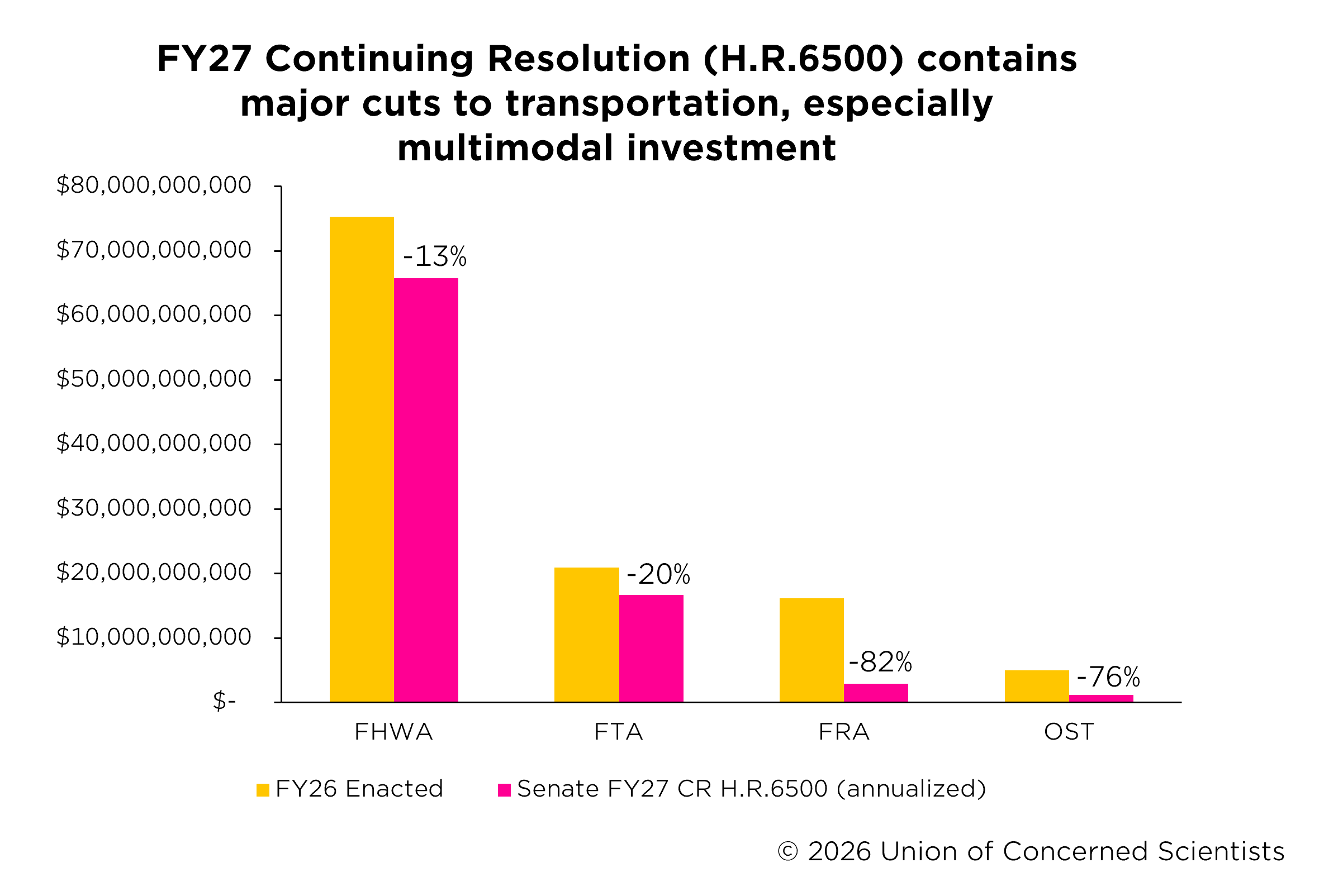
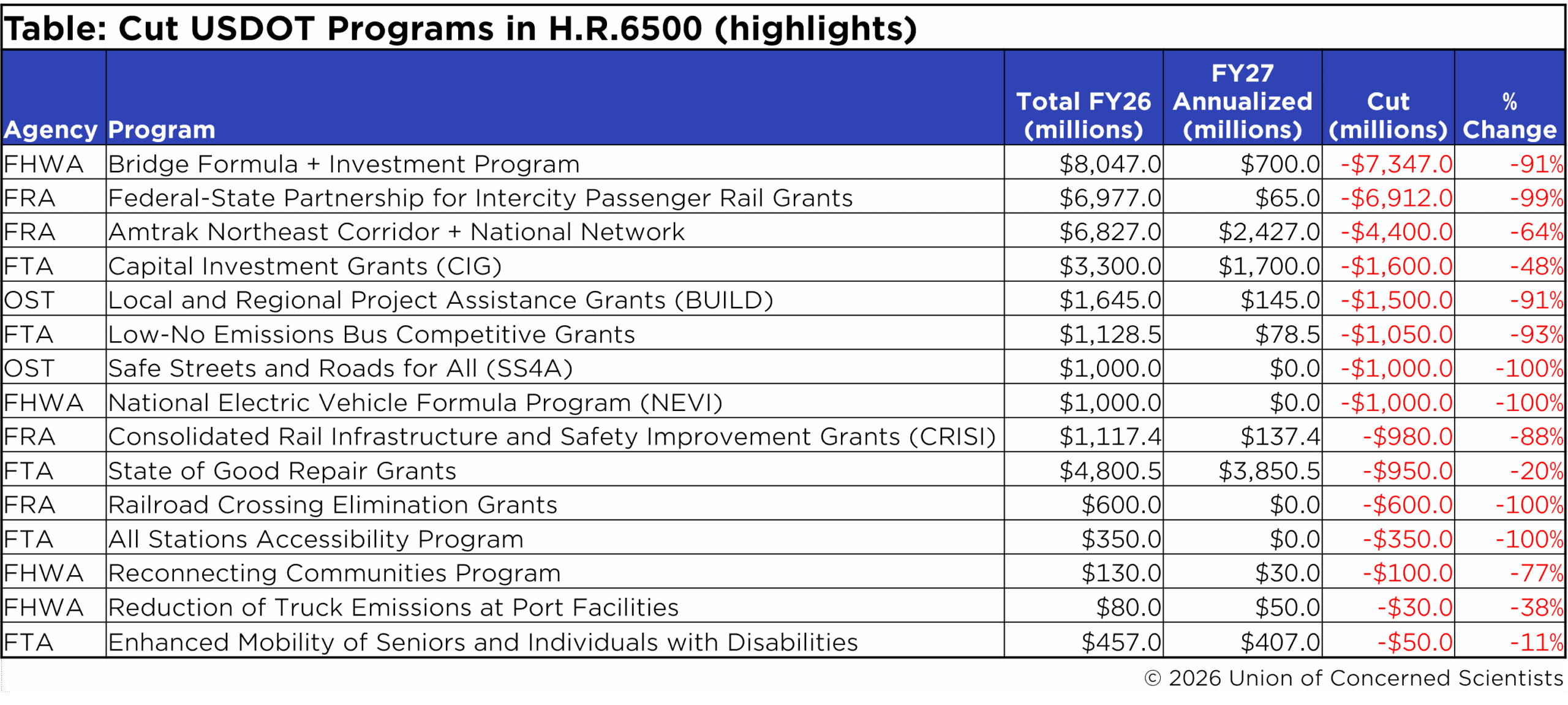
What were the programs subject to cuts? One of them is the funding for new transit rail lines and bus corridors, known as the Capital Investment Grant program, which would be cut roughly in half. This would further hinder projects that were already stonewalled by the Trump Administration, from improvements to the Green Line in Boston, MA, to the North-South Bus Rapid Transit corridor in Chapel Hill, NC, crucial investments that will offer alternatives to the high costs of car ownership. Hardest hit will be funding that is dedicated to rail, which has seen unprecedented investment in the past five years, ranging from record ridership in 2025 to the opening of new lines like the Mardi Gras line between New Orleans, LA and Mobile, AL, to the steady deployment of the new NextGen Acela trains, to the long-awaited Frederick Douglass Tunnel in Maryland to alleviate one of the biggest bottlenecks on Amtrak’s Northeast Corridor.
Road funding isn’t spared either – despite an over $40 billion annual maintenance backlog, bridge funding will be cut significantly without any measures to prioritize roadway maintenance over expensive expansions. The federal electric vehicle charging program will be gutted, just in time to stymie progress after Pennsylvania celebrated installing its 50th charging station funded by the National Electric Vehicle Infrastructure program. Safe Streets for All funding was gutted as well – which provides key funding for projects like sidewalks near schools, speed humps, Americans with Disabilities Act compliance, and bicycle lanes that in the end keep our streets safe for everyone (e.g., Kalamazoo and Detroit, MI).
Congress has known about these potential impacts – in May, Senator Cantwell outlined the stakes of such cuts in a series of reports for freight infrastructure, investments in Main Streets, and rail. Yet, they still chose to go through with them.
Congress’ rationale comes from the fact that IIJA used a funding mechanism to provide nearly 30% of USDOT spending called advance appropriations, in the bipartisan deal with 11 Republican and 10 Democratic Senators in 2021. How we fund our transportation system has long been convoluted and wonky – my colleague Dave Cooke dedicated a whole blog series to explaining it.
Since the building of the Interstate Highway System started in 1956, federal transportation funding has enjoyed relative certainty and loose budgetary rules, especially compared to other federal funding for education, housing, or the environment that goes through the yearly toils of appropriations.
This mainly comes from the user-pay myth – where for decades, transportation has paid for itself via fuel taxes. In 2008, a new trend started, where Congress bailed out the Highway Trust Fund (HTF) using General Funds to stay solvent. Despite the Interstate Highway System’s official completion in 1992, the main spigot for highway funding was kept open, without the necessary changes to meet demand for more transportation options or meet highway maintenance goals.
The programs funded by advance appropriations – funding for electric vehicle charging, reconnecting communities, rail investment, transit maintenance and expansion, and much more – were secured with the same multi-year certainty as other HTF-funded programs and similarly draw from General Funds to do so. And in the end, they also are protected from certain budgetary restrictions and had an overwhelming bipartisan consensus.
Yet, while this funding has propelled these areas of transportation forward, a sudden funding cliff (the largest since 1956, according to the highway lobby) threatens all of this progress. It risks a blow to the resurgent rail industry and pipeline of projects, the growth of electric vehicle charging already under attack by the Trump administration, and the much needed maintenance to transit vehicles and facilities and services for older adults and people with disabilities.
Regardless of budgetary mechanisms, in the end, a cut is a cut. Communities across the country will feel this in the coming months, amid tight budgets, high gas prices, and strained transit services. For over a third of the folks in the country who do not drive, cuts to funding for safe streets, transit, and rail hit extra hard.
The inclusion or exclusion of programs previously funded by advance appropriations is mostly a matter of political will. While there are some complications with this funding’s emergency designation and its impacts on discretionary spending caps, Congressional appropriators have the choice of whether to include the funds.
Sens. Collins (R-ME), Murkowski (R-AK), Moran (R-KS), Rounds (R-SD), Coons (D-DE), and Shaheen (D-NH) were part of the bipartisan group that negotiated for the advance appropriations funds in the first place. In addition, 46 Senators have called on the appropriations committee to adequately fund transit and rail programs funded by advance appropriations (Feb 12, Feb 27, May 12), and the bipartisan House Problem Solvers Caucus has also decried the impacts of the substantial funding cuts. Ultimately, appropriators let the funding falter in the most recent continuing resolution, H.R.6500, signed on September 2, and decided to defend funding dedicated to highways at its expense.
Meanwhile, in the full reauthorization proposal in the House, the BUILD America 250 Act, this same advance appropriations funding was also excluded. In that proposal, the House committee agreed to make up for some lost advance appropriations funding by finding the money from another source – including over $36 billion for bridge investments and $4.7 billion for transit maintenance. In short, legislators are well aware of the ways to fund programs previously funded by advance appropriations; they just need the extra push to prioritize them.
While the current extension goes until December 11, 2026, there will likely be more through the rest of the year and in the future, with transitions to a new Congress and a crisis over the debt limit that will add more challenges to transportation negotiations. However, the current continuing resolution sets a dangerous precedent – and if future extensions follow the same trend, these cuts might become enshrined for longer than a couple of months. Any future extension needs to revert to true FY26 funding levels for advanced appropriations programs.
We’ll be following the process – and you can stay up to date as we continue to push for a surface transportation reauthorization that works for all.