
President Trump Abandoned Environmental Justice Communities. Scientists Can Fill the Void.
The Equation Read More [[{“value”:”
Chitra Kumar co-authored this blog post.
Since the emergence of the environmental justice movement in the 1980s, environmental advocates, scholars, leaders, and communities on the front lines of pollution have understood the role of science as a tool for exposing and validating environmental harm.
The environmental justice executive order signed by President Bill Clinton more than 30 years ago marked a crucial step in recognizing those inequities. President Donald Trump’s executive orders rolling it—and many other protections—back reflect a broader pattern of undermining and weakening environmental safeguards against toxic pollution exposure and limiting communities’ ability to prepare for and recover from climate change-fueled disasters that are not of their own making. That’s why scientists at nongovernmental organizations, universities, and other levels of government must step in to work with the most-harmed communities and help fill the void left by federal government.
The consequences of the Trump administration’s actions are clear. Distressingly, policies meant to protect the public’s health are eroding, and environmental justice communities continue to bear disproportionate burdens.
Every community deserves the right to a safe and healthy living environment—the right to safe drinking water, clean air, and land free of toxic contamination. These principles have long underpinned the EPA’s mission.
The public should be able to count on the federal government to standardize and coordinate environmental and energy policies that govern economic and land use decision making. Regulations often serve to level the playing field for industry, cut out confusion across jurisdictional borders, and provide a backstop when state or local decisions fail to protect public health and the environment.
Increasingly, that role is being reversed. Under President Trump, the current administration, across all offices and departments, has prioritized fossil fuel interests and corporate polluters over community protections and scientific integrity—to the point of using taxpayer dollars to pay off developers to cancel US clean energy projects against our own interests.
In an administration that has overwhelmingly favored fossil fuel expansion while attacking policies, programs, and research that serve the public interest, scientists have a critical duty to support communities with their unique set of tools, expertise, and resources.
That is an ongoing goal for UCS that we were able to put into practice at the December 2025 American Geophysical Union (AGU) annual meeting in New Orleans, Louisiana—to encourage the scientific community to see themselves as spokespeople for scientific integrity, especially for the most vulnerable among us. As the largest conference of earth and space scientists globally with 20,000 attendees, it offered a forum for sharing innovative science. More importantly, it was an opportunity for researchers, policymakers, and advocates to explore solutions to pressing environmental and societal challenges and an important platform for elevating local experiences.
With the area known as Cancer Alley just 30 miles north, New Orleans is not only proximate to some of the nation’s most egregious and visible examples of environmental injustice, it is also the site of one of the most devastating climate change-fueled disasters in US history, Hurricane Katrina. Community leaders—who had been fighting for more resilient housing and emergency preparedness—found themselves in the same debates as before Hurricane Katrina. Coming together with community members and scientists at a time President Trump is politicizing disaster aid was an opportunity to connect more directly with the lived realities of environmental injustice and disproportionate environmental burdens. It was also an opportunity to listen to what deregulation means for local people.
For instance, with the leadership of two leading environmental justice organizations, WE ACT for Environmental Justice, a Harlem-based organization with national reach, and the Louisiana-based Healthy Gulf, we organized a Toxics Tour connecting AGU participants and environmental researchers to energy and industrial pollution, disaster recovery and restoration in Plaquemines Parish, LA, just an hour outside of New Orleans.
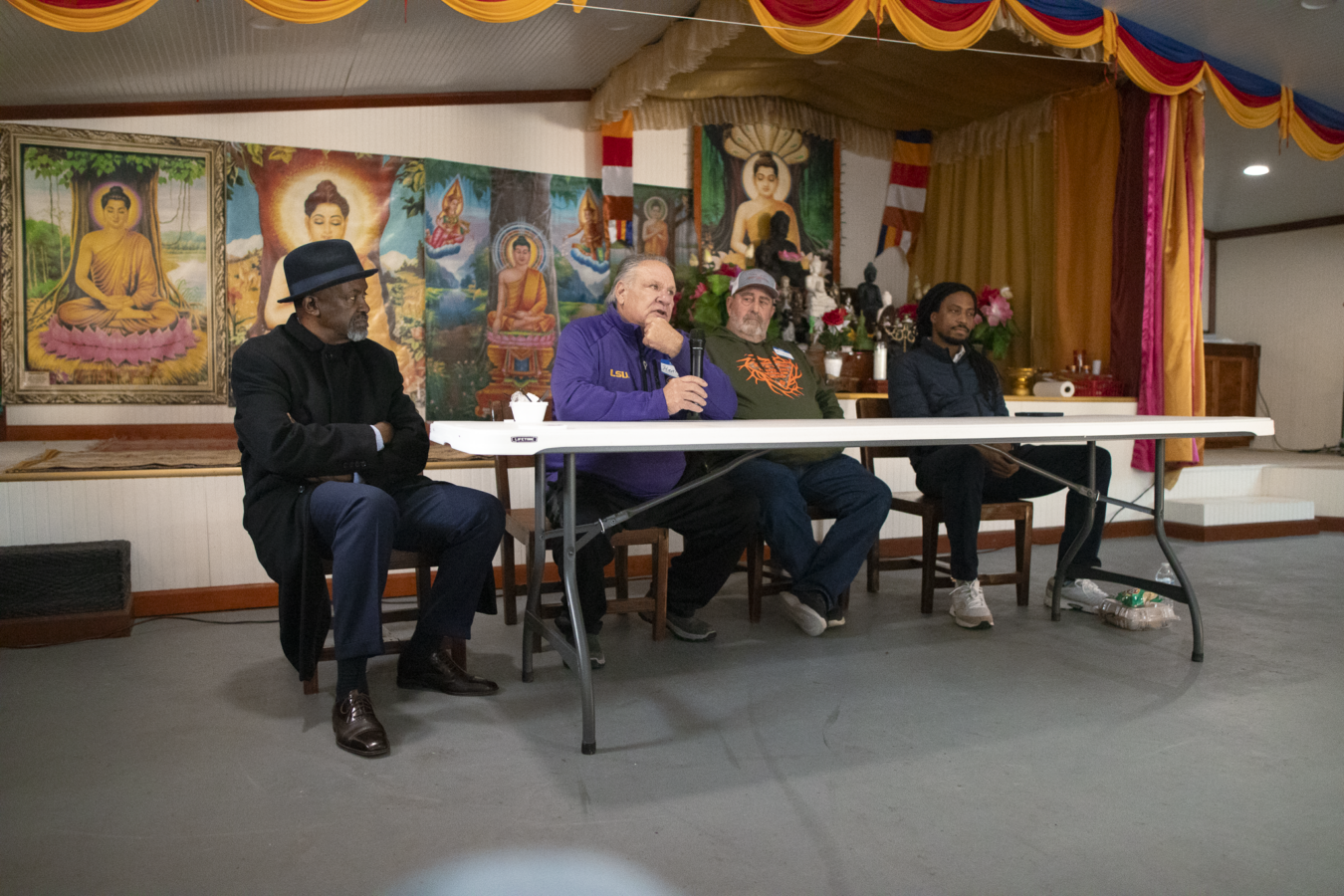
We also hosted a panel session featuring environmental justice leaders from Louisiana like Sharon Lavigne and Caitlion Hunter of Rise St. James from Cancer Alley, and a former Tulane University research scientist, Dr. Kim Terrell. The discussion was moderated by Jane Patton of the Center of International Environmental Law, whose work focuses on the human rights and environmental harms of the fossil fuel and petrochemical industries, helping to connect local experiences to broader global accountability efforts.
These community-based scientists, advocates, and researchers who expose environmental injustices have faced intimidation, funding cuts, and institutional barriers. One example they shared is a 2024 Louisiana law to stop community air quality monitor data from being used in compliance or enforcement decisions. The law goes so far as to impose up to $30,000 in penalties on groups that publicly discuss their use of the pollution monitors. This kind of intimidation is happening in other states too, according to UCS senior analyst Darya Minovi, who also presented at AGU.
This administration’s antagonism towards environmental justice has created more academic censorship, which Dr. Terrell faced by Tulane University for reporting findings of environmental injustice in the petrochemical industry. She is now with the Environmental Integrity Project continuing her work. With Louisiana scientists under pressure, it is even more important for the broader scientist community to continue researching the harms the fossil fuel industry is causing there.
One of the stops on the toxic tour at AGU was the Plaquemines liquefied natural gas (LNG) terminal—part of the fossil gas infrastructure in Louisiana that handles 61% of US LNG exports. The site exemplifies long-known high-climate change impact risk areas where, because of corporate greed, fossil fuel facilities continue to be permitted and financed. The Plaquemines terminal was built in an area clearly susceptible to chronic flooding, coastal erosion, and health impacts to workers and residents for its profit potential for financiers and the insurers that underwrite them. Meanwhile, homeowners in Louisiana and elsewhere experience a growing protection gap as insurers leave coastal states citing increasing climate risk.
Beyond the insurance crisis and exposure to pollution, Louisiana’s coastal areas are ground zero for other deadly impacts of climate warming. Particularly exposed are people living in Plaquemines, St. Bernard, Terrebonne, Lafourche, Cameron parishes. There, concentrations of low-income households are already facing land loss, subsidence, and rising seas. UCS’s 2024 analysis Looming Deadlines for Coastal Resilience, identified public and affordable housing among the most-threatened infrastructure in coastal states, including Louisiana. Without major resilience investments, affordable housing stock will become increasingly uninhabitable, the analysis found.
Extreme heat, the deadliest climate impact, compounds the dangers these communities face. That threat is intensified for people living in older, poorly insulated, or substandard affordable housing, according to a 2025 UCS study, Colliding Crises: The Dangers of Extreme Heat in Affordable Housing.
Louisiana is among the states with the largest number of affordable homes exposed to three or more weeks of extreme heat alerts in 2024, the report found.
Like Louisiana, other states and the country face a mounting need for housing systems that better adapt to and protect against climate impacts. Meanwhile, we face a federal government that is acting against our interests and taking steps that will accelerate the pace of climate change.
That’s why it is important for Congress to also take action—to ensure greater protections for environmentally overburdened communities. Sadly, environmental justice voices continue to “pull up a folding chair” to the table in legislative debates, as the first black woman elected to the US House of Representatives Shirley Chisholm famously said.
Yet, frontline communities have long persisted—using science, data, and advocacy to fight for health, safety, and justice as the government puts fossil fuel companies’ interests above theirs.
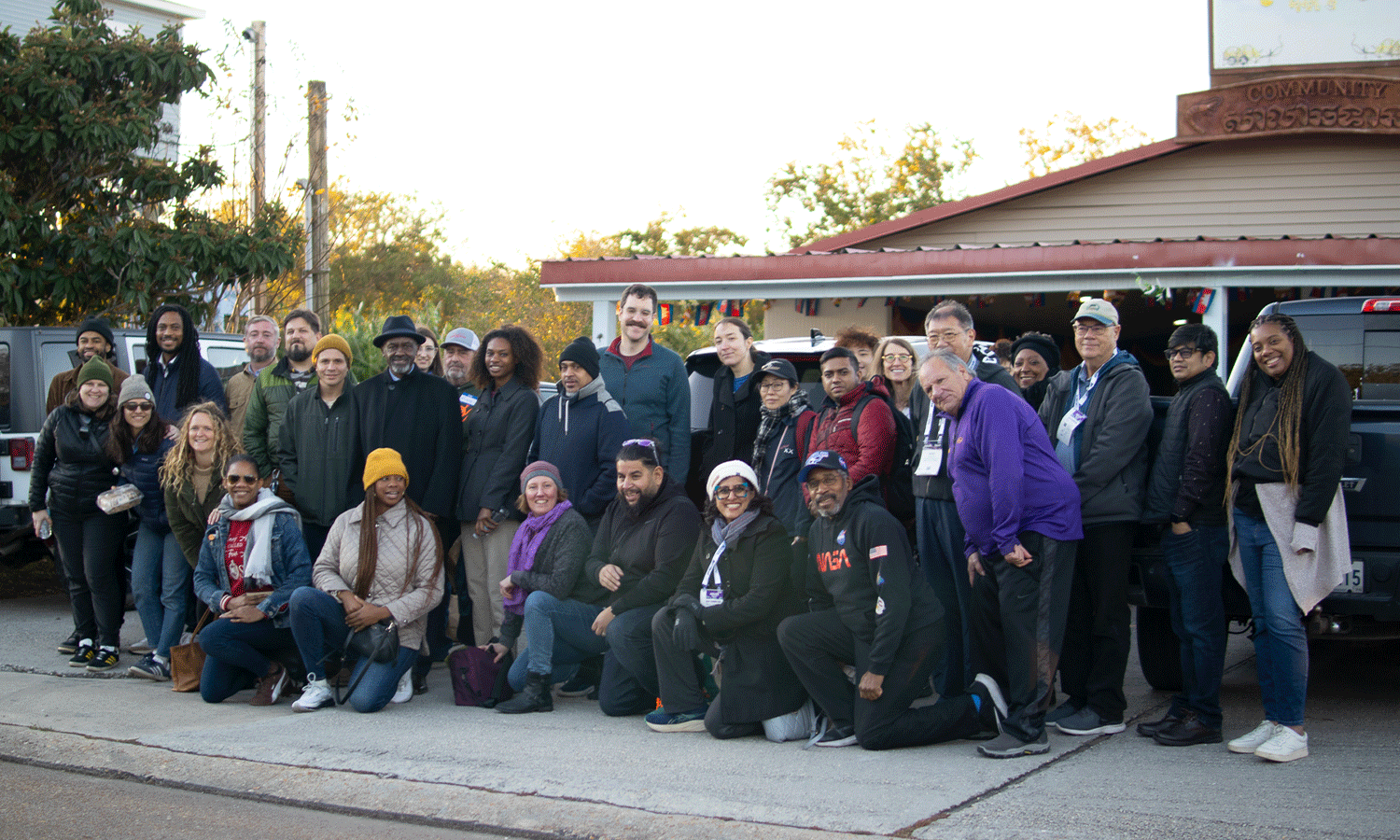
This moment calls for engagement across the scientific community and beyond. Scientists, advocates, and community members all have a role to play in defending science-based policy and supporting environmental justice. At the Union of Concerned Scientists (UCS), we are using all the tools at our disposal to challenge the rollbacks of federal protections through the courts, organize our supporters to speak up, provide opportunities for scientists to support communities, produce elucidating analyses, and stand with scientists and frontline communities during difficult challenges.
Defending science and advancing justice requires an “all hands-on deck” approach. You, too, can help by:
- Speaking out in support of science-based environmental protections by supporting sign-on letters, writing op-eds, or participating in expert testimony or contacting your legislators. UCS provides many opportunities.
- Supporting and working directly with organizations working in and alongside frontline communities.
- Engaging in public comment opportunities and policy processes.
- Advocating for restoring funding for climate science, environmental justice and resilient infrastructure investment.
- Joining our Science Network so we can keep you informed about future events at scientific conferences, like AGU.
Special Mention: Special appreciation to all who made our organizing efforts at AGU possible, including Samuel Kay and Bria Crawford as individual contributors, Kelly Crawford (UCS National Advisory Board member), and Manuel Salgado and Tali Natter of WE ACT for Environmental Justice.
“}]]