
The Highway Lobby Spends Millions to Make Sure We Pay Billions
The Equation Read More [[{“value”:”
Communities across the country want more transportation choices, but currently, for most people, a personal car and all its costs is the only option. All the while, the oil, automotive, roadbuilding, and trucking industries have lobbied for decades to keep us lining their pockets. A new analysis by academic researchers Orly Linovski, Nicholas Klein, Amy Lee, Kelcie Ralph, and UCS examines how these vested interests cozy up to policymakers to maintain the status quo. The paper finds that the highway lobby employs hundreds of lobbyists, spends over $100 million every year, uses a full suite of advocacy tactics, and brings along public officials to keep us all in a car-dependent transportation system.
This is the latest in a long line of UCS work showing the influence of corporations on public policy. UCS has worked to expose how oil, gas, and coal companies have knowingly deceived the public, manufactured counterfeit science, and blocked climate action for decades. We have exposed the auto industry’s long history of using exaggerated rhetoric, misinformation, and political influence to fight against standards that deliver better cars to the nation and lower emissions.
This comes at a time when journalists have highlighted US Department of Transportation (DOT) Secretary Sean Duffy’s ties to the transportation industries the agency regulates, citing campaign donations to his son-in-law’s congressional campaign. But the influence of the highway lobby runs even deeper than that, and until recently, was an underrecognized throughline in the history of our transportation system.
The highway lobby has been shaping transportation policy conversations for decades in its interests. It’s the fossil fuel industry that wants you to burn more gasoline. It’s auto manufacturers who want to keep you buying more cars. It’s the engineering consultants who get paid to design and build new highways. It’s the asphalt and aggregate producers who want more roads to get paved. It’s the trucking companies that tear up the roads but want to pay less for their upkeep.
That’s where this research study comes in. In their paper, the researchers focused on eight different trade associations that represent the highway lobby industries: the American Council of Engineering Companies (ACEC), the American Road & Transport Builders Association (ARTBA), the American Trucking Associations (ATA), the Associated General Contractors of America (AGC), the National Asphalt Paving Association (NAPA), the National Association of Manufacturers (NAM), the National Stone, Sand & Gravel Association (NSSGA), and the US Chamber of Commerce (US CoC), along with multiple coalitions. The full list of the highway lobby is much larger, but these are some of the more prevalent groups.
“While other trade associations organize fly-ins once a year, the ATA Federation has a permanent presence in the halls of Congress year-round, with state associations visiting weekly on a rolling basis” – ATA 2023
These industries are those that benefit the most from the highway-oriented status quo. In UCS’ report, “Freedom to Move: Investing in Transportation Choices for a Clean, Prosperous, and Just Future,” we find that over 80% of US transportation spending, public and private, goes to the auto, oil, and roadbuilding industries. My colleague Dave Cooke has written about how the trucking industry causes more than 90% of roadway damage while paying far less than its fair share for upkeep—and how the industry is pushing to further reduce its financial contribution to our transportation system. The trade associations above are how companies in these industries exert their influence as members or on boards of directors. Companies like Ford, Shell, ConocoPhillips sit on the board of the US CoC, and Toyota, BP, and ExxonMobil sit on the board of NAM, among many others in the roadbuilding and trucking industries.
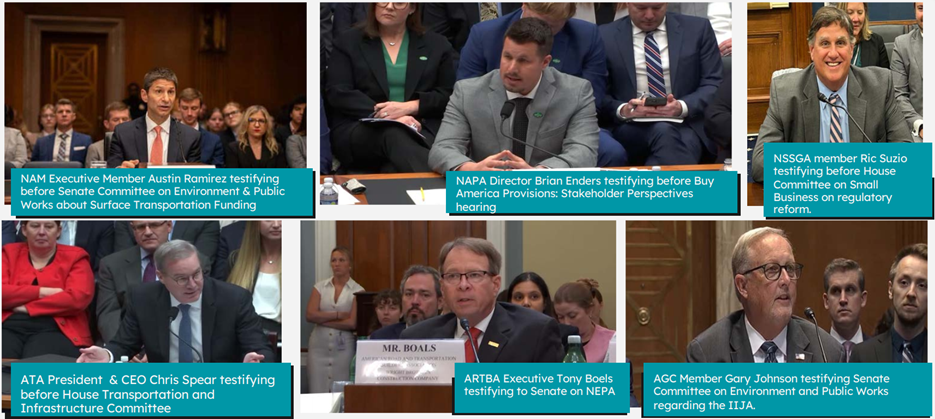
These industry groups are well practiced and well-funded to lobby hard. The eight organizations analyzed in the paper collectively employed over two hundred lobbyists, spending over $100 million on lobbying and political donations. With this amount of resources, they are able to employ the full gamut of tactics such as:
- Direct lobbying of legislators and policymakers. The most direct line to influencing public policy is to talk to decisionmakers—whether that’s hiring former Congressional staffers or political appointees to meet legislators on policy priorities; having organizational heads testify in Congress; or commenting on rulemakings like one recently rescinded by the Trump administration setting targets for heat-trapping emissions from transportation. Most of these activities are federally required to be recorded in lobbying disclosures, which you can explore for yourself on OpenSecrets.org.
- Engaging industry members. Every organization in the paper mobilizes its association members to fly into Washington DC and talk to legislators on Capitol Hill. The scale of this is striking—in the course of nine months in 2021, the researchers found the US CoC excited to share that they held more than 330 meetings and events with members of and sent them more than 3,600 letters. During one so-called fly-in in April 2023, ATA had 332 meetings with members of Congress, and they continue to maintain ongoing weekly Congressional visits. AGC frequently inserts lobbying materials into paycheck envelopes (i.e. payroll stuffers) to get employees at member firms to reach out to their members of Congress.
- Shifting public opinion. These organizations are seasoned and leverage extensive media campaigns. US CoC organized regional press calls, social media campaigns, and placed ads in dozens of districts on the last surface transportation reauthorization. As another example, AGC installed provocative billboards in a Pennsylvania congressman’s district after he voted to prioritize maintaining existing highways—before expanding them—in the bipartisan INVEST in America Act, a commonsense approach that would address the nation’s maintenance backlog.
- Industry-funded policy research. Almost all of the associations have an affiliated research institute or foundation that provides an appearance of independence while supporting industry priorities.
The American Transportation Research Institute? That’s the research arm of ATA. The Transportation Development Foundation? That’s ARTBA. Yet their funding sources and staff almost always come from the same place, with the same motives. The problem—scientific literature has documented how industry-sponsored research is more likely to produce favorable results for the sponsors. In addition, these organizations benefit from tax-deductible donations to these “neutral” spinoffs. - Fund political campaigns: The last tactic researchers highlighted was direct support to political candidates, parties, or political action committees (PACs). By influencing who is in the decisionmaker’s seat, trade associations push for candidates who are more friendly to their business interests. Six of the eight trade associations investigated are in the top 5% of political contributors in the US, spending over $13 million in 2024 alone.
In sum, the researchers uncovered an extensive number of ways that the oil, auto, roadbuilding, and trucking industries exert their influence on our transportation system for their benefit. Their experience and political connections are deep – in their materials, they emphasize working with state departments of transportation and public officials to advance their own industry-oriented campaigns.
“In all cases, the governor and/or state DOT director was a strong proponent of the legislation, either visibly or behind the scenes” – ACEC, 2021
The oil, auto, roadbuilding, and trucking industries continue to hold back our transportation system today. They are out front calling to have taxpayers contribute more to their own bottom lines. Often, the highway lobby shows up as the same groups under slightly different coalition configurations (e.g. the Transportation Construction Coalition). Sometimes, these coalitions put public officials and industry groups signing onto the same letters (e.g. the Move America coalition, United for Infrastructure), raising ethical concerns about the influence of corporate self-interest in government.
The result of the highway lobby’s activities?
- Transportation is the second highest household expense, with the average US household spending over $12,000 a year on owning and operating vehicles.
- Over 90% of people in the US don’t have access to frequent transit.
- Roadway maintenance strains state and local budgets while the federal government continues to support expensive highway expansions.
- The US transportation system continues to be the country’s biggest contributor to climate change and a major source of inequities.
In short, our transportation system currently doesn’t have enough sustainable, affordable, and equitable transportation options, and the highway lobby has mounted an extensive campaign to keep it that way.
While the scale of the highway lobby is eye-popping, there is a diverse and science-based coalition of community, environmental, business, labor, disability, transportation professional groups, and many more who are standing up for the public interest alongside everyday individuals. As history shows, from the tobacco wars to fighting industrial polluters for environmental justice, when we assemble community-based coalitions to counter industry interest, we can win.
That’s where UCS comes in—as an independent organization in the public interest that doesn’t take government or industry money. You can find out more about UCS’s research and join our work toward a people-centered transportation future here. This latest research has shown that the highway lobby has loomed over transportation policy, past and present. Now it’s time for something different.
“}]]