
Why Linking Data Systems at Trump’s USDA Isn’t Enough. (And Might Be a Disaster for Farmers.)
The Equation Read More [[{“value”:”
The US Department of Agriculture (USDA) operates a sprawling array of farmer assistance programs aimed at promoting US agriculture, buffering farms and the food supply from risk, and protecting our soil, water, and air from agricultural pollution. In an op-ed published in Iowa earlier this month, Secretary of Agriculture Brooke Rollins announced a two-year data modernization effort that would “[deliver] a single, streamlined record that follows the farmer—no matter where they go in the USDA system.” She promised results including less red tape, expedited approvals of grant applications, and program dollars reaching farmers “faster than a seed sprouts.”
In what might be a first, I agree with Rollins . . . in a way. I think it’s a good idea to connect these disparate subsidy programs, currently run by different agencies within the USDA and tracked using separate systems. But while it may be true that the IT systems are clunky and redundant, a much bigger problem is that the aims of the programs are so disconnected that they often work at cross purposes and fail to deliver lasting benefits to farmers, farm economies, taxpayers, and the public. Rather than just a superficial linking of farmer data and application forms, we need true synergy of program goals and outcomes, and Rollins’ plan won’t do anything about that.
Moreover, I’m deeply concerned about how this administration is going about overhauling these information systems in the name of efficiency—in particular, contracting with Palantir Technologies, one of today’s most notorious and antidemocratic corporations, to do the work (more on that later).
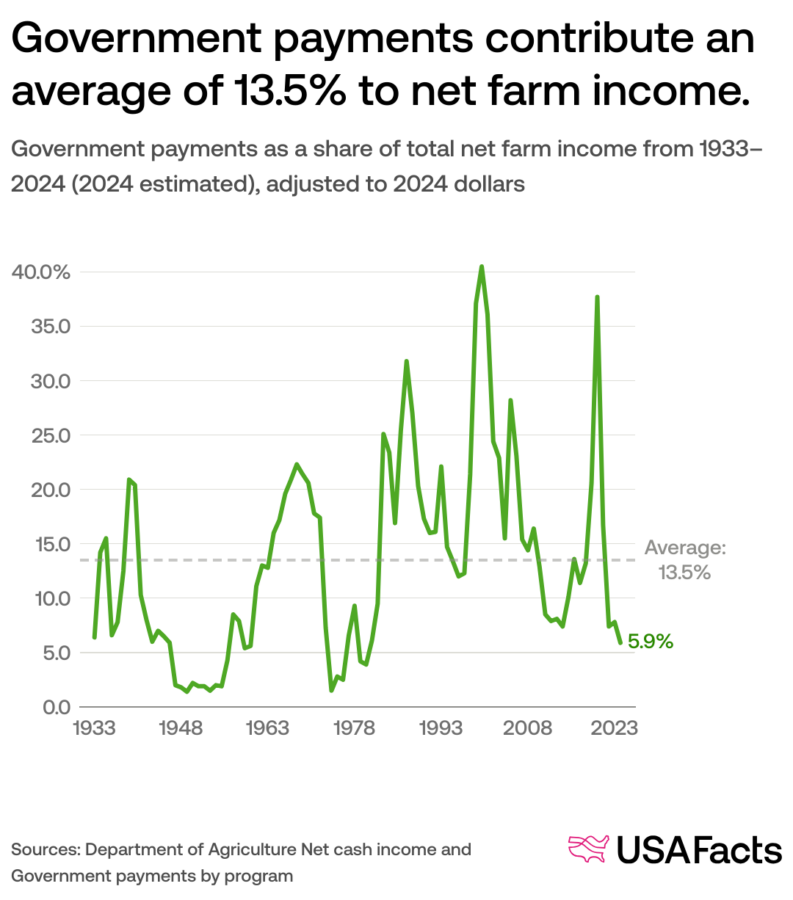
First, let’s back up and take a look at what the USDA programs in question have in common: distributing public money to farm operations. While many farmers and observers like to think of agriculture as a free-market system, that is far from the truth. Farming is heavily subsidized—based on USDA data, USAFacts estimates that federal agricultural subsidies since 1933 have averaged 13.5 percent of net farm income.
The USDA administers a wide variety of farm payment programs, but they generally fall into three major categories:
- Crop insurance and disaster assistance. The USDA’s Risk Management Agency (RMA) oversees the Federal Crop Insurance Program, which insures farm operations against crop losses and underwrites the cost of insurance premiums. The RMA also operates programs including the Supplemental Disaster Relief Program, which provides additional compensation to crop insurance policyholders for losses related to qualifying natural disasters.
- Commodity price supports. The Farm Service Agency (FSA) administers programs including Agriculture Risk Coverage and Price Loss Coverage, which provide payments when farm revenue or covered commodity prices fall below set levels. These outcomes can be spurred by all kinds of economic forces and events, including some we’re seeing today: tariffs and trade wars, for example, and rippling disruption from a literal war.
- Conservation incentives. The largest voluntary programs that compensate farmers for undertaking conservation and pollution reduction practices on working farms are operated by the Natural Resources Conservation Service (NRCS). These include the Environmental Quality Incentives Program and the Conservation Stewardship Program.
In 2024, the Government Accountability Office (GAO) reviewed all the programs that distribute taxpayer dollars to farmers and ranchers and tallied a total of $161 billion over the prior five years—an annual average of $32 billion.
The GAO report found that more than 40 percent of farmer payments during fiscal years 2019 through 2023 addressed damage to farm income due to international trade disruptions, the COVID-19 pandemic, and natural disasters. In 2018 and 2019, for example, the USDA distributed some $28 billion through a new Market Facilitation Program (MFP) to bail out farmers hit by retaliatory tariffs on soybeans, pork, and other agricultural commodities in the wake of the first Trump administration’s ill-conceived trade war with China.
The largest farm subsidies have disproportionately gone to the largest, most industrial operations. As the libertarian Cato Institute put it recently, “Most welfare programs are for low-income families, but farm welfare is for high-income families.” This was borne out starkly during the first Trump administration: A 2020 analysis of USDA data by the Environmental Working Group showed that more than half of all MFP payments went to the top 10 percent of farms by income. Similarly, the USDA directed nearly a quarter of payments from the Coronavirus Food Assistance Program, created by Congress in 2020 to help farmers struggling during the pandemic, to just the top 1 percent of farm operations.
By the end of 2020, nearly all of the US Treasury’s gain from tariffs on China went to farmer payments. Yet despite all that spending, farm bankruptcies spiked 20 percent in 2019 and stayed high through 2020.
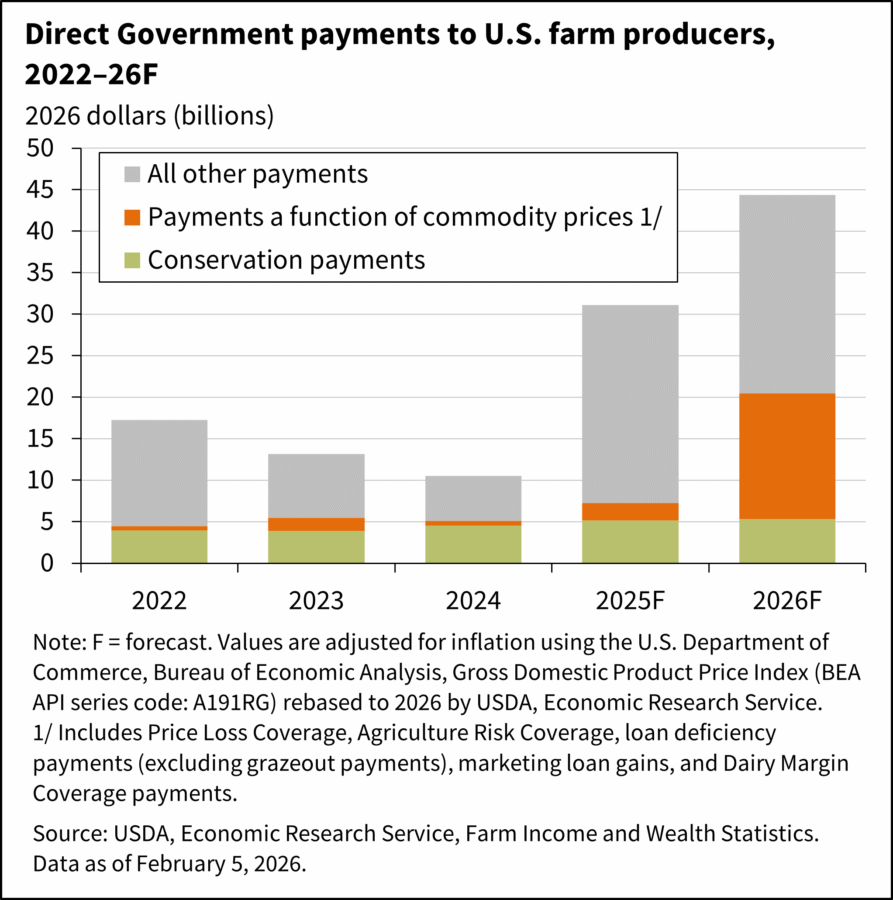
Recently, the USDA’s Economic Research Service tallied annual direct payments to farmers from all programs since 2022 and forecast the trajectory of spending through 2026. As illustrated in the graph below, conservation payments have remained flat, while price support payments and all other payments, after declining somewhat since the pandemic’s effects eased, are expected to balloon this year.
This brings me back to the USDA’s One Farmer, One File initiative. In a recent interview (paywalled), a USDA undersecretary said the effort seeks to streamline paperwork such as program application forms and eligibility documents across agencies and update internal software and data collection systems. The initiative, which is expected to be fully implemented by 2028, aims to reduce administrative time spent by both farmers and USDA staff.
That’s good, but what would be revolutionary is if the missions of the programs themselves were linked and their dollars collectively created lasting value and sustainability for farmers. That’s not happening today, and it’s not going to result from just an overhaul of data systems.
Take the interplay of the NRCS’s farm conservation programs and the RMA’s crop insurance. Science has shown that conservation practices that work with nature rather than against it—including planting cover crops and perennial crops, expanding crop rotations, and producing a wider array of crops and livestock on a farm—create healthy, spongy soils and buffer farmers from flooding, drought, and other events that commonly lead to insurance payouts and drive up premiums. A January 2023 GAO report examined options to link conservation, climate resilience, and crop insurance policy incentives, and later that year the Biden administration’s USDA took steps to make crop insurance rules work better for farmers using resilience-building practices.
But much more action is needed to bring about a fully integrated and self-reinforcing policy framework that requires higher levels of soil, water, and climate stewardship by all producers as a condition of receiving farm subsidies (as I proposed in this blog post in 2024). Such an integrated policy should also expand existing technical and financial support to ease the transition for farmers who have been locked out of conservation programs or have been reluctant to try them.
If we did this, it would be good for farmers of all kinds, who would begin to see the benefits of reduced reliance (and spending) on fertilizers and other inputs, greater flood and drought resilience from healthier soil, and more profitability. (See, for example, the story of an Iowa farmer who voluntarily adopted conservation practices and documented benefits that added up to an improved bottom line.)
Benefits would also accrue to taxpayers (decreased crop insurance costs from extreme weather), local water utilities and their customers (lower costs for removing agricultural pollution from drinking water, and better health outcomes), commercial fisheries (smaller dead zones), hunters and outdoor enthusiasts (cleaner rivers and streams for swimming and fishing, more waterfowl habitat), and consumers (better food access from diversified farms).
Fundamentally linking farmer assistance programs in the way I’ve described is a long-term goal. In the meantime, streamlining these programs’ IT systems must be done carefully and with attention to participant privacy and data security. As much as Secretary Rollins talks about “putting farmers first,” I was surprised (okay, not really) to hear that the USDA had contracted with Palantir—an AI-based company that has been called “the most dangerous corporation in America”—to develop the One Farmer, One File system.
Palantir’s founder is Peter Thiel, a billionaire venture capitalist, Trump donor, and Jeffrey Epstein correspondent who has frequently expressed anti-democratic ideas and decried diversity. And Palantir is at the center of the Trump administration’s highest-profile and most controversial data-gathering and surveillance efforts—from its contract with US Immigration and Customs Enforcement (ICE) to its work with the Internal Revenue Service and the Pentagon. Many observers have expressed alarm about Thiel’s and Palantir’s role in the rise of an authoritarian surveillance state and threats to human rights worldwide.
So now Palantir is being handed the keys to USDA farmer data. What could possibly go wrong?
“}]]