
Your Anti-Disinformation Safety Chain for Danger Season
The Equation Read More [[{“value”:”
We’re now officially in Danger Season 2026—the period between May and October when North America experiences its worst climate impacts—and we should expect disinformation to ramp up on social media and other platforms. It’s the time when maintaining what I call the “safety chain” matters most. When this chain is strong, we have what we need to understand the extreme weather and disasters worsened by climate change that may be coming our way, be ready for them, and recover from them as quickly and humanely as possible.
Unfortunately, there’s not a link in this chain the Trump administration, and particularly the Director of the Office of Management and Budget Russell Vought, hasn’t weakened by cutting funding, firing scientists, refusing oversight, evading accountability, and spreading outright disinformation. When climate change impacts collide with an anti-science administration whose policies are hurting us economically, Danger Season is triply dangerous.
The “safety chain” is the term I use for the series of links that protect us during Danger Season and climate change-worsened disasters. It’s made up of accurate data that give us clear, easy to understand weather forecasts that, when delivered by trusted communicators, increase public understanding so that individuals and communities prepare effectively and—if needed— respond and recover well.
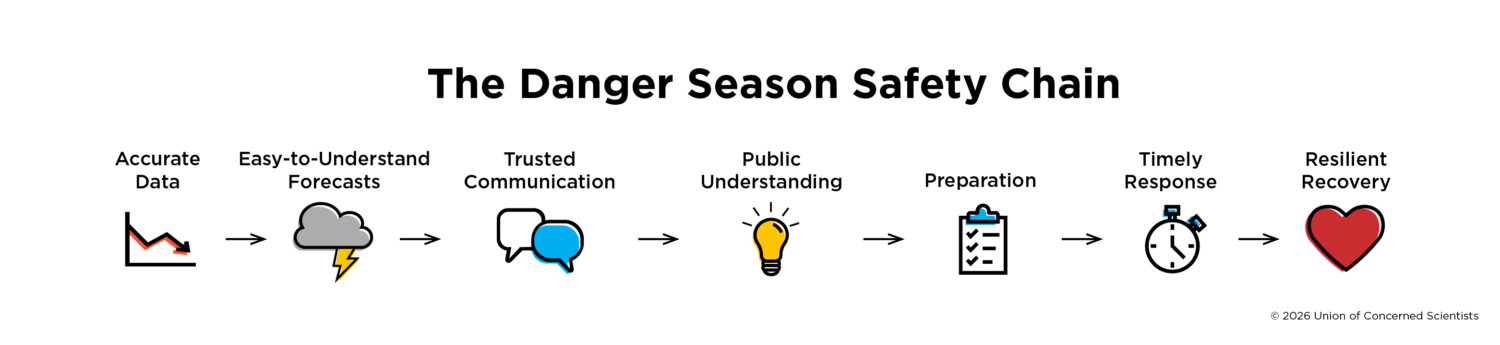
The Trump administration has stopped gathering data and supporting research crucial to understanding our climate system. This assault on federal climate research in turn undermines weather forecasting. And that is further compounded by an administration that is actively spreading disinformation about climate science, echoing long-standing talking points of the fossil fuel industry.
President Trump himself in his previous administration refused to correct an error he made in a hurricane forecast and forced his administration to cover for him during “SharpieGate.” Lying about the path of a hurricane weakens the ability of science communicators, including meteorologists, to inform the public.
Meanwhile, it’s been a 15 month long roller-coaster ride for the Federal Emergency Management Agency (FEMA) under the Trump administration. The agency has undergone loss of qualified leadership which was replaced by unqualified leadership, leading to a brain drain and raising questions about the agency’s readiness.
President Trump has delayed and denied disaster assistance for blue states and attempted to cancel initiatives within FEMA that would support local preparation, such as the Building Resilient Infrastructure and Communities or BRIC program. But after two federal court orders, the Department of Homeland Security (DHS) finally issued a notice of funding for $1billion of the $4.6 billion available appropriated by the Infrastructure Investment and Jobs Act and from FEMA’s Disaster Relief Fund (DRF) set-aside.
FEMA’s disaster response funds were dangerously low even before Danger Season had begun and got a sorely needed boost once Congress ended the DHS shutdown. Even with a slightly milder than average Atlantic hurricane season expected, the DRF will most likely need Congress to provide supplemental appropriations mid-season.
Meanwhile, former acting FEMA administrator Cameron Hamilton, who lacks the qualifications required under law and has admitted to sharing misinformation about the agency on social media, is now back as a nominee to lead the critical agency.
Given Trump administration actions that have depleted federal emergency management with thousands of job cuts, unstable leadership, and resource reductions, FEMA is less prepared to confront more frequent and intense extreme weather and climate change-fueled disasters.
During climate change-worsened weather disasters, fossil fuel companies, aligned political actors, and affiliated media and advocacy networks have repeatedly spread or amplified disinformation that undermines public understanding, trust in institutions, and support for climate and disaster-response measures. These disinforming claims tend to fall into five main categories:
- Cause distortion. A social media post that falsely attributes wildfire to arson, for example, breaks the links between accurate data, forecasting, and understanding. People may under- or over-react to risk.
- Blame distortion. When we don’t see the role climate change plays in worsening weather disasters, we don’t hold the principle corporate drivers of climate change, such as the fossil fuel industry, accountable. We blame the wrong actors and don’t adequately address the root causes of the problem.
- Trust attacks. Claims that government agencies or officials “don’t know what they’re talking about” or “don’t care about us” break the communication that builds trust and leads to effective preparation. People may ignore warnings or delay action, for example by refusing to evacuate ahead of a hurricane. At the same time, the Trump administration is making it harder to know what government actions or motivations are likely to be.
- False safety signals, on the other hand, break the chain between understanding, preparation, and response. People may delay evacuation or miss the opportunity to take other needed precautions because they’re getting signals, either from authorities or media, that there is no emergency. It’s important to note that this doesn’t have to be disinformation or other propaganda. For example, showing pictures of people enjoying beach time can send a false safety signal during a dangerous heat wave.
- Narrative hijacking happens when bad actors deliberately entangle disaster warnings, preparedness, or response with harmful messaging on hot-button issues such as elections or immigration. Targeted people may avoid shelters, services, or official channels of communication.
First, borrow from the Hippocratic Oath, and do no harm. Check your sources, especially before you share something on social media. A host of tools are available to help you conduct a search, check timestamps, and generally trace information to its source. The Climate Action Against Disinformation (CAAD) coalition releases briefs and data monitors showing trends in climate and weather disinformation campaigns.
Secondly, keep good information sources like the National Weather Service and local emergency response agencies on hand. For understanding science-based connections between climate change and extreme weather, keep an eye on UCS’s Danger Season content and on the great work of our partner organization Climate Central. Share good sources when you can; when good information is absent, disinformation will fill the void.
Third, pay attention to the intersection of extreme weather, disasters, and hot-button issues. Watch out if you see distortions and attacks come into play. If you do, use UCS’s host of resources on how to counter disinformation effectively.
Finally, work with us as we demand that Congress fund and oversee the restoration of crucial links in the safety chain, from appropriate oversight to funding for federal climate science and disaster preparedness and response.
“}]]